Chinese culture · A place to start
Chinese Dynasties: A Timeline You Can Actually Follow
A beginner’s timeline from Shang to Qing, with dates, overlapping periods, and one Qin story.
AI-assisted · Reviewed by the project owner on November 5, 2026
November 3, 2026 · Sources linked below
What is a Chinese dynasty?
A dynasty is a succession of rulers from a ruling family. A dynasty chart helps you place a story or an object in time. It does not tell you that everyone lived under the same ruler, spoke the same language, or followed one set of customs.
Think of the names as signposts. You can use one without memorizing the whole road.
Media selection · Reviewed by the project owner on November 5, 2026. Context images do not replace the story’s cited evidence.
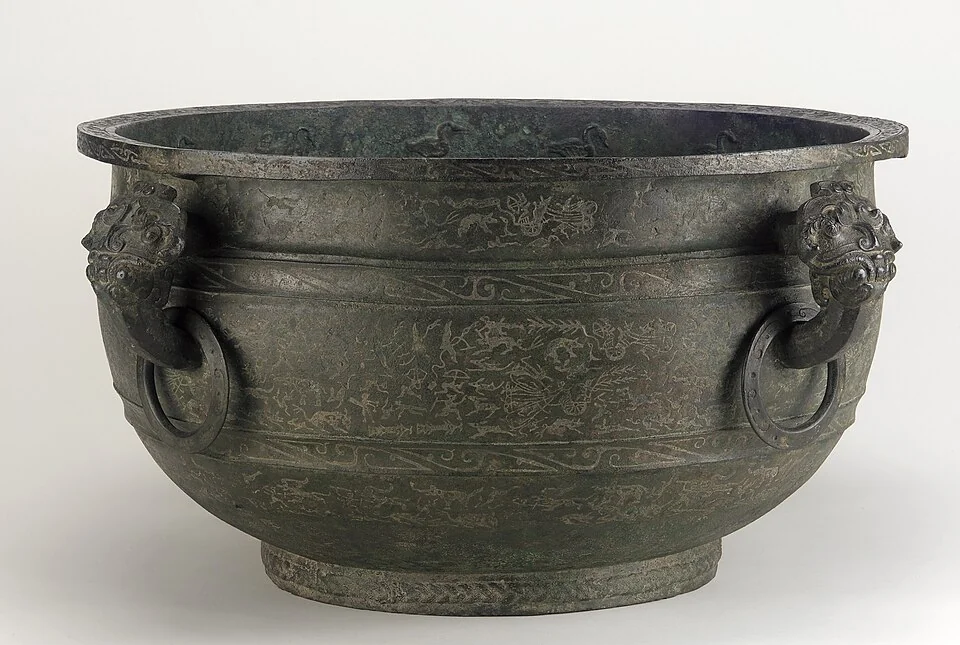
A bronze vessel offers an object-level anchor for early history. Its record supplies the period.
Image source & license
Unknown artistUnknown artist · CC0. WebP delivery copy; resized if needed, composition unchanged. Original image & full credit · License
Chinese dynasties, in order—with the gaps left in
Dates below follow the Smithsonian’s teaching overview where listed. Sui, Five Dynasties and the notes on interruptions draw on the Oxford chronology. The Oxford full page was not accessible in this check; its indexed timeline was available. [D1] [D2]
These periods are not a single relay: some governments existed at the same time. Yuan: the dynastic name dates to 1271, while 1279 marks the conquest of Southern Song. Qing: this chart uses 1911; abdication came in 1912. [D1] [D2] [D4]
BCE counts down toward the common era; CE counts up. “ca.” means approximately. Open a row for a little context.
Shangca. 1600–1050 BCE
Start with bronze objects and early writing.
Explore a related cultural story →Zhouca. 1050–221 BCE
A long umbrella period, not centuries of one unchanging government.
Qin221–206 BCE
Short enough to miss on a crowded chart; important enough not to skip.
Han206 BCE–220 CE
This label spans centuries and includes an interruption by the Xin dynasty.
Explore a related cultural story →Period of Division220–589 CE
Several states and dynasties: this is a period label, not one ruling family.
Sui581–618 CE
Notice the overlap with the division period: regional timelines meet at different dates.
Tang618–907 CE
A useful starting label for exploring art and literature.
Five Dynasties907–960 CE
A period of changing regimes; not a single dynasty.
Song960–1279 CE
Northern and Southern Song belong within this broad label.
Explore a related cultural story →Yuan1279–1368 CE
1279 marks the conquest of Southern Song; the dynastic name dates to 1271.
Ming1368–1644 CE
Look for this label on a museum object, then read the object’s own record.
Explore a related cultural story →Qing1644–1911 CE
This art-historical convention ends in 1911; the last emperor abdicated in 1912.
Explore a related cultural story →
One ruler. A very long afterlife.
The Qin ruled for only a short stretch, but the first emperor’s burial complex gives that small timeline row a very large physical presence. The Smithsonian’s history timeline connects the first emperor with his tomb and terracotta army. [D3]
That is an easier way in than a memory test: one short dynasty, one enormous burial project. It does not make the army a model for modern Chinese funerals.
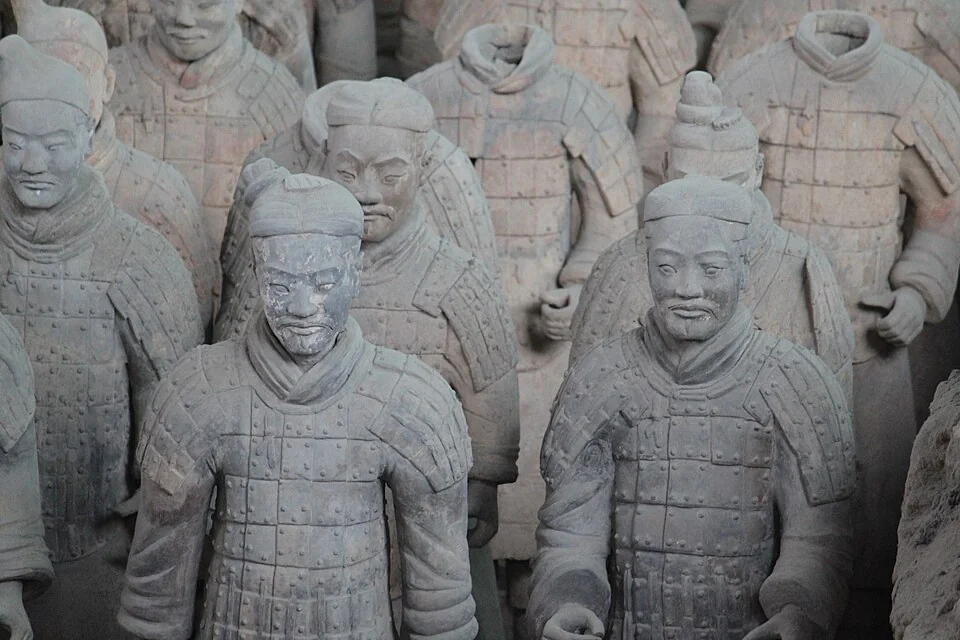
Terracotta figures in a Qin context: one ruler’s burial project, rather than a model for later funerals.
Image source & license
Gary Lee Todd, Ph.D. · CC0. WebP delivery copy; resized if needed, composition unchanged. Original image & full credit · License
An American comparison—just for the calendar
Imagine a US museum label that says “Colonial period.” The phrase helps place an object, but it does not name a single family that ruled every place on the continent. This is our imagined comparison: a period label and a ruling house are different kinds of information. Their histories are not equivalent.
Why do two charts give different dates?
They may be marking different events. The Smithsonian gives Yuan as 1279–1368, while Oxford starts the Yuan name in 1271. A label can track a dynastic proclamation, control of a region, or the end of another state. Qing endings likewise appear as 1911 in these art and literature timelines; abdication came in 1912. Do not treat one boundary as a switch that changed everyone’s life overnight. [D1] [D2] [D4]
This is a beginner’s outline, not every dynasty. Liao and Jin overlapped with Song; Xia is not included because its historical identification needs a separate explanation. Modern China is not another dynasty.
Take one detail into a museum
Try a more useful question than “Is it ancient?” Ask: “Which period does the record give, and what does it tell us about this particular object?”
Open the culture notebookThe notebook is general purpose. It does not automatically copy dates from this page.
Sources & scope
- D1 · Smithsonian — Explore by Dynasty (opens in a new tab). Museum teaching chronology, not a complete political atlas.
- D2 · Oxford — Timeline of Chinese Dynasties (opens in a new tab). Indexed chronology read; full page unavailable through the reading tool.
- D3 · Smithsonian — History, art and culture timeline. Indexed text supports emperor and terracotta-warrior connection; full page unavailable in this check.
- D4 · US Office of the Historian — Chinese minister’s February 1912 letter. Primary diplomatic notice of the February 12 abdication.